Charles Verlat
1824 – 1890
In short
Charles Verlat (1824–1890) was a Belgian painter and art educator. He was a versatile artist known for his realistic depictions, particularly in animal painting and portraiture. Verlat also directed the Antwerp Academy, where he famously clashed with a young Vincent van Gogh.
Notable works


Early life
Charles Verlat, also known as Karel Verlat, was born in Antwerp, Belgium, in 1824. His early life and artistic training took place in this vibrant city, a significant centre for the arts in Belgium. Details regarding his specific upbringing and initial artistic education are not widely documented, but his later career indicates a solid foundation in academic artistic principles.
Career and style
Verlat established himself as a prominent figure in the Belgian art scene of the 19th century. His artistic output was remarkably diverse, encompassing a wide range of subjects and genres. He is primarily associated with the artistic current of realism, a movement that sought to depict subjects truthfully and objectively, without artificiality or artificial elements. Verlat's approach to realism was evident in his meticulous attention to detail and his commitment to representing the world as he saw it.
He gained particular recognition as an 'animalier,' excelling in the portrayal of animals. His understanding of animal anatomy and behaviour allowed him to create lifelike and dynamic depictions. Beyond animal subjects, Verlat was also a skilled portrait painter, capturing the likeness and character of his sitters with considerable skill. His oeuvre extended to include Orientalist scenes, reflecting the 19th-century fascination with the cultures of the Middle East and North Africa. Genre scenes, religious compositions, and still lifes also featured in his body of work, demonstrating his versatility and broad artistic interests. Notably, he also explored singeries, which are artistic representations of apes behaving like humans, often in a humorous or satirical context.
Verlat's career was not solely focused on his own artistic production. He was also a dedicated art educator. He held a professorship in drawing and eventually rose to the position of director of the prestigious Antwerp Academy. This role placed him at the heart of art education in Belgium during a pivotal period.
Signature techniques
Verlat's technique was deeply rooted in the academic traditions of his time, yet infused with the observational rigour of realism. His paintings are characterised by a precise draughtsmanship, evident in the clear delineation of forms and the accurate rendering of anatomy, whether human or animal. He employed a refined brushwork that allowed for the subtle modulation of light and shadow, creating a sense of volume and three-dimensionality. His colour palette often reflected the natural world, with a keen eye for the accurate representation of textures and surfaces. In his animal paintings, this meticulous approach resulted in works that were both scientifically accurate and artistically compelling.
He was adept at conveying movement and vitality, particularly in his depictions of animals. This was achieved through careful composition, dynamic poses, and a sensitive use of line. His portraits, too, benefited from this attention to detail, with a focus on capturing the sitter's individual features and personality. The overall impression of his work is one of polished craftsmanship and a deep engagement with the subject matter.
Major works
Among Charles Verlat's notable works is "A dog barks at a cockatoo," created in 1850. This early piece showcases his burgeoning skill in animal depiction, likely capturing a moment of lively interaction between the two creatures with characteristic realism.
In 1866, Verlat painted "Portrait of the painter Joseph Lies." This work highlights his proficiency as a portraitist, offering insight into his ability to render the character and presence of fellow artists. The painting serves as a testament to his connections within the Antwerp art community.
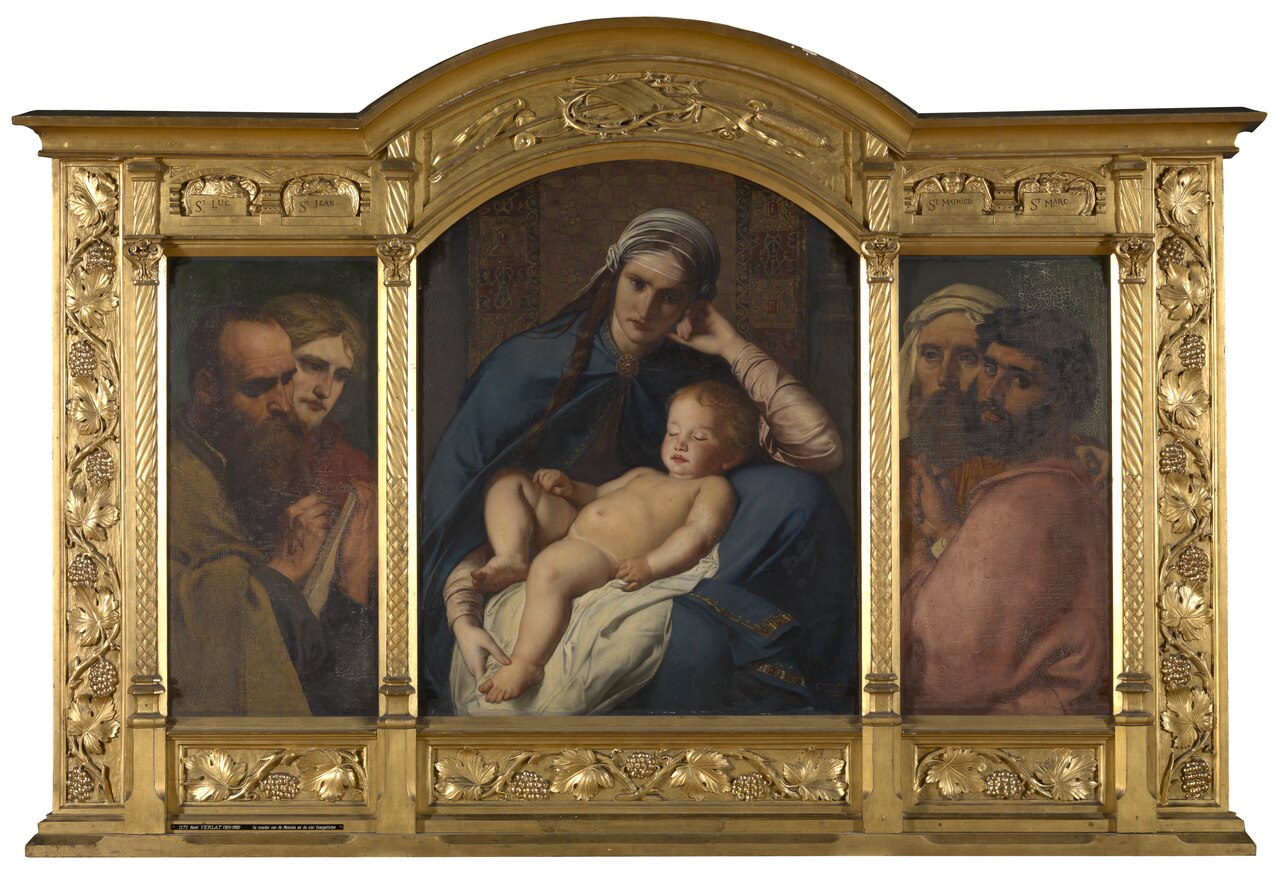
"Mother of the Messiah and the Four Evangelists," completed in 1873, demonstrates Verlat's engagement with religious subject matter. This composition would have required a different approach to composition and symbolism compared to his genre or animal works, showcasing his versatility in tackling profound themes with academic precision.
Perhaps one of his most dramatic works is "Een beer overvalt een houthakker, genaamd 'Strijd op leven en dood'" (A bear attacks a woodcutter, titled 'Struggle for life and death'), painted in 1874. This ambitious piece exemplifies his talent for capturing intense action and raw emotion. The dynamic composition and realistic portrayal of the struggle between man and beast underscore his mastery of dramatic narrative in painting.
Influence and legacy
Charles Verlat's influence stems from his role as a respected artist and, significantly, as an educator. As director of the Antwerp Academy, he played a part in shaping the artistic development of numerous students. His tenure coincided with a period of significant artistic change, and his own adherence to realism provided a grounding in established techniques for his pupils.
His interactions with Vincent van Gogh during the latter's brief but notable period as a student at the Academy in 1886 are a point of historical interest. Van Gogh, who was developing his highly individualistic and expressive style, reportedly clashed with Verlat over drawing methods. Verlat, representing a more traditional, academic approach, found van Gogh's unconventional techniques challenging. This episode, though brief, highlights the generational and stylistic shifts occurring in art and Verlat's position within the established art world of the time.
Verlat's legacy lies in his contribution to Belgian realism, particularly his accomplished animal paintings and portraits. He represents a generation of artists who balanced academic training with a commitment to truthful representation. His works remain examples of skilled draughtsmanship and keen observation, contributing to the rich tapestry of 19th-century European art.
Frequently asked questions
Who was Charles Verlat?
Charles Verlat (1824–1890) was a Belgian painter, known for his realism, particularly in animal subjects and portraits. He was also an influential art educator and director of the Antwerp Academy.
What art movement was Charles Verlat associated with?
Charles Verlat was primarily associated with the art movement of realism. His work focused on objective and truthful representation of his subjects.
What are some of Charles Verlat's most famous works?
Notable works by Charles Verlat include 'A dog barks at a cockatoo' (1850), 'Portrait of the painter Joseph Lies' (1866), 'Mother of the Messiah and the Four Evangelists' (1873), and 'Een beer overvalt een houthakker, genaamd 'Strijd op leven en dood'' (1874).
Why is Charles Verlat considered important?
Verlat is important for his contributions to Belgian realism, especially his skilled animal paintings and portraits. His role as director of the Antwerp Academy also shaped art education, and his interactions with Vincent van Gogh are historically significant.
How can I recognize a painting by Charles Verlat?
You can recognize a painting by Charles Verlat by its realistic style, meticulous detail, and often precise draughtsmanship. Look for accurate depictions of animals or portraits, executed with a polished, academic technique characteristic of 19th-century realism.